In 2014, I was trying to decide which language to learn next and came to the conclusion that if I chose French, the Germans would be offended, and if I chose German, the French would be insulted 😂 So I decided to study something neutral — and that’s how I came to Esperanto.
Esperanto was created in 1887 as an auxiliary means of international communication, free from the cultural biases of natural languages. Its grammar and initial vocabulary were compiled by Eliezer Zamenhof, an ophthalmologist who knew thirteen languages simply because life required it of him — and who was frustrated by that fact: if everyone shared a common auxiliary language, he would have had to learn only one instead of twelve that weren’t native to him. Since then, Esperanto has remained the most widely used constructed language in the world. The number of speakers is estimated at around 10 million, with about 2 million active users, and roughly 2,000 native speakers.
Since then, I’ve been constantly improving my Esperanto. I listen to music and read books; I make sure that out of the 100–120 books I read every year, at least five are in Esperanto. I follow several blogs, my favorite being La Ondo de Esperanto. I’m a member of the Israeli Esperanto Association (ELI) and correspond with Esperantists from other countries — mostly by Email, but also through handwritten letters.
I try to promote the language whenever possible. In particular, at each of my workplaces I’ve given a lecture about Esperanto:

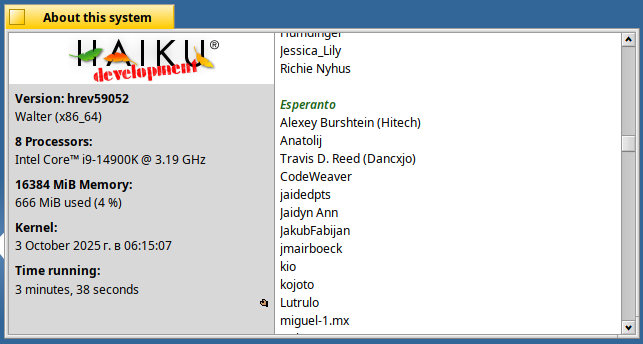
In addition, I translated the interface of the Haiku operating system into Esperanto:
I truly believe it’s a language of the future — simple, convenient, easy to learn, and expressive enough to say anything one can possibly want to say.